

Menopause Jet Lag: Why Travel Wrecks Sleep and Hot Flashes
Yes, jet lag commonly makes menopausal symptoms worse, and it’s not in your head. Crossing time zones disrupts the same hormonal systems already destabilized by perimenopause, which is why a trip that used to cost you one groggy day can now cost you three miserable nights. The fix starts before you board.
- Get outside within 90 minutes of waking at your destination.
- Set the hotel room cold before you even unpack.
- Skip the in-flight wine, since alcohol fragments sleep and triggers hot flashes.
Pro Tip: Book your return flight or first meeting a day later than you think you need. That buffer day is what keeps a rough travel night from turning into a lost week.
Key Takeaways
Menopause amplifies jet lag’s effects on sleep and hot flashes because declining estradiol and progesterone already weaken thermoregulation and sleep continuity before travel adds circadian disruption on top.
| Point | Details |
|---|---|
| Jet lag compounds menopause symptoms | Hormonal shifts already occurring in menopause make circadian disruption from travel hit harder and longer. |
| Light timing resets your clock fastest | Get outside within 90 minutes of waking at your destination to re-entrain quickly. |
| Recovery takes longer than average | Budget more than one day per time zone crossed, and expect a harder day three. |
| Protect sleep to reduce hot flashes | Nighttime awakenings can trigger hot flashes, so cooling your room protects both sleep and symptoms. |
| Pack for precise, portable dosing | Nukalove’s Deep Zzzs oral strips offer travel-friendly, timed sleep support for destination bedtimes. |
Table of Contents
- What Happens During Menopause Jet Lag
- How Crossing Time Zones Disrupts Sleep and Hormones
- Why Menopause Makes You More Vulnerable to Jet Lag
- Pre-Flight Checklist: What To Do 3 to 7 Days Before You Travel
- Your First 24 to 48 Hours: Resetting the Clock and Managing Hot Flashes
- How Long Recovery Actually Takes
- Melatonin, Sleep Aids, and Hormone Therapy: What’s Actually Safe
- What the Research Actually Shows
- A Traveler’s Honest Take on Managing Jet Lag Through Menopause
- A Travel-Ready Way to Support Menopausal Sleep
- Frequently Asked Questions
- Sources
What Happens During Menopause Jet Lag
Your circadian rhythm is a roughly 24 hour internal clock run by a cluster of neurons in your brain called the suprachiasmatic nucleus. It tells your body when to release melatonin, when to raise core temperature, and when to feel alert. Jet lag happens when you cross time zones faster than that clock can adjust, so your internal schedule and the local sun fall out of sync.
Three signals reset that clock: light, meal timing, and when you sleep. Get those cues right at your destination, and your body follows. Get them wrong, and you stay stuck on home time regardless of what the clock on the wall says.
The clock doesn’t care what time zone you’re in. It only responds to the signals you give it, mainly light.
That’s why the timing of your actions matters more than the actions themselves once you land.
How Crossing Time Zones Disrupts Sleep and Hormones
Melatonin production naturally declines with age, and travel compounds that by pushing your release schedule hours out of alignment with local darkness. You might feel wide awake at 10 p.m. local time and then crash at 3 a.m., exactly when you need to be up.
Your core body temperature also follows a daily rhythm, dropping to its lowest point a few hours before you’d normally wake. Jet lag shifts that temperature nadir out of sync with actual nighttime, and for menopausal travelers this collision tends to intensify hot flashes and night sweats rather than simply cause fatigue.
Add cortisol to the mix. Your stress hormone is supposed to rise in the morning and taper by evening. Time zone shifts throw that curve off too, producing the classic “tired but wired” feeling: exhausted, yet unable to fall or stay asleep.
- Melatonin release lags behind local darkness for several days after a long flight.
- The temperature nadir shift intensifies vasomotor symptoms at night.
- Cortisol mistiming causes wakefulness precisely when you most need rest.
Sleep disturbances already affect an estimated 40 to 60% of women during the menopausal transition and postmenopause, and travel stacks a second layer of disruption on top of that baseline.
Why Menopause Makes You More Vulnerable to Jet Lag
Perimenopause and menopause change the biology that jet lag exploits. Falling progesterone matters here specifically because progesterone has sleep-promoting effects, and declining estradiol interferes with the temperature regulation that normally keeps you asleep through the night. Lose both, and a normal circadian disruption lands much harder.
- Estradiol decline undermines thermoregulation, worsening night sweats during time zone shifts.
- Fragmented sleep and more frequent awakenings become more common after menopause even without travel.
- Sleep-disordered breathing risk rises with age, and travel fatigue can mask or worsen its symptoms.
- Vasomotor symptoms and mood changes interact with travel stress to compound sleep loss.
Watch for signs that point past ordinary jet lag: loud snoring, gasping awake, or daytime sleepiness so severe it interferes with normal function. Those symptoms warrant a conversation with a clinician about sleep apnea screening, not just a better travel routine. Interestingly, nighttime awakenings can actually trigger hot flashes rather than the reverse, which means protecting sleep continuity itself reduces flash frequency, not just discomfort.
Pre-Flight Checklist: What To Do 3 to 7 Days Before You Travel
Start shifting your sleep schedule three to five days before departure. Traveling east means going to bed earlier each night; traveling west means staying up later. West is generally the easier direction to adjust to, since it asks your body to stay awake longer rather than fall asleep before it’s ready.
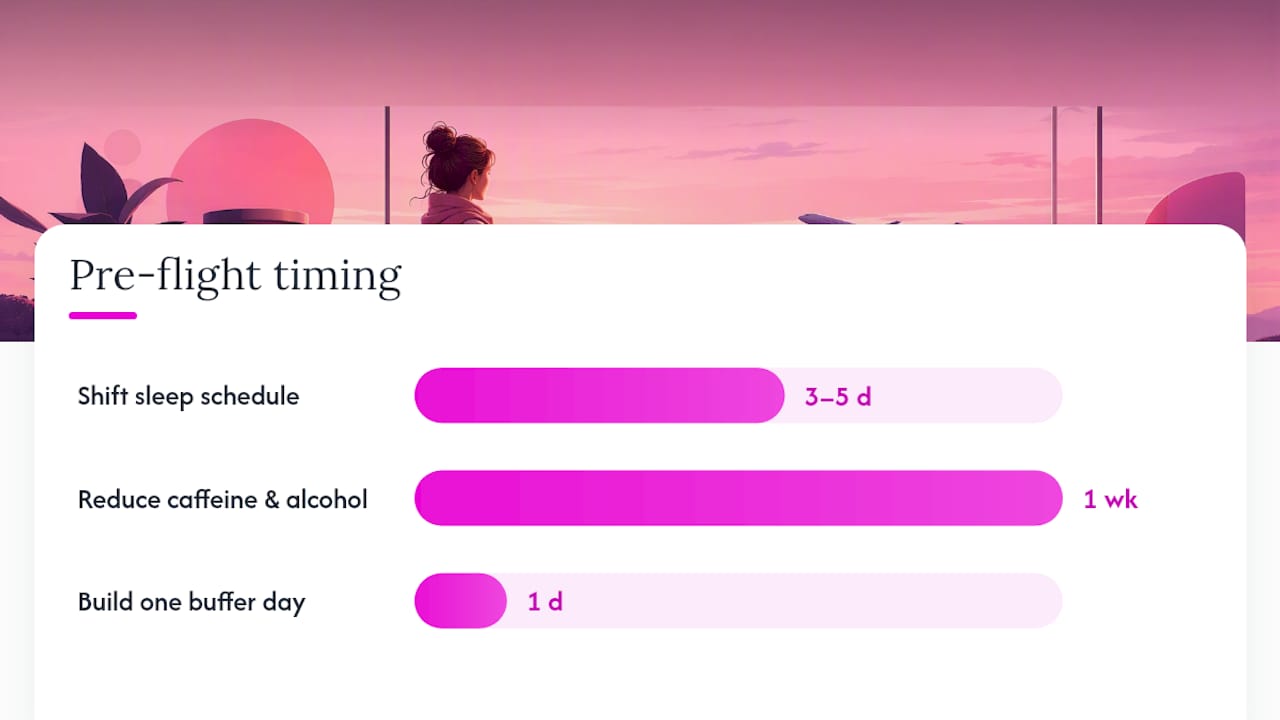
Cut caffeine after early afternoon in the days leading up to travel, and go easy on alcohol, since both worsen the fragmented sleep menopause already causes. Timing caffeine around hot flash sensitivity matters even more once you’re jet lagged.
If you take hormone therapy or other daily medications, map out your dosing schedule against your destination’s clock before you leave, and confirm any adjustments with your prescriber rather than guessing on the plane. Pack for temperature control: a portable fan, moisture-wicking sleepwear, and a cooling towel take up little space and solve a real problem. When booking, ask hotels about thermostat range and blackout curtains before you commit.
- Shift bedtime by 30 to 60 minutes per day starting several days out.
- Reduce caffeine and alcohol intake in the week before flying.
- Confirm medication timing across time zones with your clinician.
- Pack cooling tools and breathable fabrics, not just extra layers.
- Build one buffer day into your itinerary before anything important.
Your First 24 to 48 Hours: Resetting the Clock and Managing Hot Flashes
Get outside as soon as possible after waking on your first destination morning, ideally within about 90 minutes of waking. A 20 minute walk in natural daylight is one of the strongest tools available for resetting your internal clock, and it costs nothing.

Keep naps short, under 30 minutes, and take them before mid-afternoon so they don’t compete with nighttime sleep. Eat meals on the local schedule immediately, even if your appetite disagrees. This meal timing acts as a second entrainment signal alongside light.
If you use melatonin, take a low dose (0.5 to 3 mg) roughly 30 minutes before your target local bedtime, only for the first few nights. Skip it if you’re on hormone therapy or other medications without checking for interactions first.
For hot flashes, set the room as cold as it goes before bed, layer bedding you can shed easily, and keep a portable fan and cooling towel within reach.
- Walk outside in daylight within 90 minutes of waking.
- Cap naps at 30 minutes, taken before 3 p.m. local time.
- Eat on the local meal schedule from day one.
- Use low-dose melatonin only short term, and check interactions first.
Pro Tip: Match your in-flight sleep to your destination’s clock rather than your departure city’s. It feels counterintuitive to stay awake on a night flight, but it prevents your body from anchoring to the wrong schedule.
How Long Recovery Actually Takes
The old rule of thumb is roughly one day of recovery per time zone crossed. Menopausal travelers often need more than that, since hormonal shifts already reduce the amplitude of the circadian signal your body relies on to re-entrain quickly.
Expect day one to feel manageable on adrenaline, and expect a real dip around day three, when accumulated sleep debt and travel fatigue tend to collide. That’s the point where people tend to overschedule and derail.
Seek medical attention if insomnia persists beyond a week, hot flashes intensify rather than settle, or you notice signs pointing to sleep apnea rather than ordinary travel fatigue.
- Budget roughly one recovery day per time zone crossed, more if symptoms are already active.
- Expect a harder day three rather than steady daily improvement.
- Get evaluated if symptoms worsen instead of easing after a week.
Melatonin, Sleep Aids, and Hormone Therapy: What’s Actually Safe
Short-term, low-dose melatonin timed to your destination bedtime is reasonable for most travelers, but it isn’t meant for nightly long-term use, and it can interact with certain medications. Over-the-counter sleep aids work similarly: fine for a rough night or two, not a real fix, and none of them pair well with alcohol.
Hormone therapy deserves its own conversation with your prescriber before you travel, because addressing vasomotor symptoms directly tends to reduce the sleep disruption driving your jet lag misery in the first place, not just the jet lag itself.
For anyone dealing with insomnia that outlasts the trip, cognitive behavioral therapy for insomnia (CBT-I) remains the most durable, evidence-backed option, ahead of any pill.
- Use melatonin at low doses, short term, timed to destination bedtime.
- Treat OTC sleep aids as occasional tools, not habits.
- Discuss HRT timing and dosage adjustments with your clinician before departure.
- Ask about CBT-I if insomnia persists well past your trip.
Pro Tip: If you’re deciding between melatonin and a non-hormonal alternative, read up on sleep support without melatonin before you fly, not the night before a big meeting.
What the Research Actually Shows
The clearest data point: sleep disturbance affects 40 to 60% of women during the menopausal transition, which means jet lag is layering onto a system already under strain for most travelers in this life stage, not a minority.
The evidence is strongest for light timing as an intervention and weakest for long-term melatonin use in this specific population, where more research is still needed.
- Sleep disturbance during menopause affects 40 to 60% of women, a wide and common range.
- Morning light exposure has the best evidence behind it for resetting circadian timing.
- Long-term melatonin safety data specific to menopausal travelers remains limited.
A Traveler’s Honest Take on Managing Jet Lag Through Menopause
Travel stress used to mean a bad night’s sleep. After 45, it started meaning three bad nights and a flare of hot flashes that ruined an entire trip. What changed things was treating the first full day at the destination as a write-off on purpose: cooling kit unpacked immediately, a walk outside before checking email, and zero apologies for going to bed early.
A Travel-Ready Way to Support Menopausal Sleep
None of the timing strategies above work as well if you’re relying on a pill bottle that’s hard to dose precisely mid-flight or buried in checked luggage. Nukalove built Deep Zzzs oral sleep strips specifically for that gap: a thin, portable strip that dissolves without water, so you can time a dose to your destination’s bedtime instead of whatever’s convenient in an airport bathroom.

Precise, low-dose timing matters more than the format, but the format is what makes people actually follow through on the timing. As with any sleep aid, check with your clinician first if you’re on hormone therapy or other medications, and time your dose to local, not departure-city, bedtime. If you want more product options for travel days, the wellness collection covers cooling and energy support too. Add Deep Zzzs to your next trip’s packing list before your next flight, not after a rough first night away.
Frequently Asked Questions
Does jet lag make hot flashes worse? Yes. Travel disrupts sleep continuity, and disrupted sleep is linked to more frequent nighttime hot flashes, not just general fatigue.
How much melatonin should I take for menopause jet lag? Most guidance points to a low dose, roughly 0.5 to 3 mg, taken 30 minutes before your target destination bedtime, for a few nights only. Check with your clinician first if you’re on hormone therapy.
How long does it take to recover from jet lag during menopause? Plan on roughly one day per time zone crossed as a baseline, though many menopausal travelers need longer given existing sleep fragmentation.
Can hormone therapy help with jet lag symptoms? Not directly, but treating underlying vasomotor symptoms with hormone therapy can reduce the sleep disruption that makes jet lag feel so much worse.
What’s the fastest way to reset my body clock after flying? Morning sunlight exposure within about 90 minutes of waking at your destination is the single most effective, evidence-backed tool available.
This article is general information, not a substitute for advice from a qualified doctor. Consult a qualified healthcare professional about your own circumstances before acting on anything here.
Sources
- Sleep disturbances during menopause linked to lower quality of life — The American Journal of Managed Care
- Sleep Problems and Menopause: What Can I Do? — National Institute on Aging
- Sleep Disturbances in Menopause: Neuroendocrine Mechanisms and Clinical Implications — PMC (peer-reviewed review)
- Daylight saving time and circadian rhythm — Sleep Foundation
Bring any of these to your clinician if you want to discuss hormone therapy timing or melatonin use around travel.