

How Women Over 50 Can Sharpen Focus and Beat Brain Fog
The most effective steps for improving focus after 50 are ones you can start this week: protect your sleep, single-task during your sharpest morning hours, eat protein and healthy fats at breakfast to prevent energy crashes, move your body daily, and get a clinician to rule out reversible causes like thyroid issues or B12 deficiency. The ACTIVE trial, tracked by the National Institute on Aging, found that targeted reasoning and processing-speed training produced measurable cognitive benefits sustained over a 10-year follow-up — which means the brain stays trainable well past 50.
Your starting checklist for this week:
- Go to bed and wake up at the same time every day, even on weekends
- Eat a protein-rich breakfast within an hour of waking
- Block your first 90 minutes for your single most important task, phone on Do Not Disturb
- Walk or move for at least 20 minutes, preferably before noon
- Write tomorrow’s top three tasks the night before so you wake up with a plan
- Book a basic blood panel if brain fog has lasted more than a few weeks
Pro Tip: Reserve the first 90 minutes of your morning for focused work before checking email or social media. That window is when cortisol naturally peaks and working memory runs sharpest — protect it like a meeting you cannot cancel.
Table of Contents
- Why does focus change after 50 for women?
- Daily routines and habits that actually restore focus
- What to eat and drink to support mental clarity
- What does the research say about cognitive training?
- CLARITY Focus Strips are built for women on the move
- Sources
Why does focus change after 50 for women?
The term “menopause brain fog” describes a cluster of symptoms: forgetting words mid-sentence, losing a thought between rooms, struggling to concentrate on tasks that used to feel automatic. It is real, it is common, and — critically — it is usually not permanent.
The primary driver is hormonal. Estrogen supports blood flow to the prefrontal cortex and influences neurotransmitters like serotonin and acetylcholine that regulate attention. As estrogen fluctuates and eventually drops during perimenopause and menopause, those systems get noisier. Sleep disruption compounds everything: hot flashes fragment sleep architecture, and even one night of poor sleep measurably slows processing speed the next day. The National Institute on Aging notes that sleep problems are among the most common and most underaddressed menopause symptoms.
Mood matters too. Anxiety and depression, both more common during the menopause transition, compete directly with working memory. Certain medications — including some blood pressure drugs, antihistamines, and sleep aids — carry cognitive side effects that are easy to overlook. Add the normal age-related slowing of processing speed (not memory loss, just speed), and you have a perfect storm that feels alarming but is largely manageable.
The WHO’s menopause fact sheet frames menopause as a universal life stage with predictable, addressable symptoms — not a medical emergency. The NCOA puts it plainly: most midlife memory problems trace back to concentration, tiredness, and stress rather than actual brain-cell loss. That distinction matters for how you approach it.
Red flags that need prompt evaluation (not typical brain fog): rapid cognitive decline over weeks, getting lost in familiar places, or new difficulty with routine tasks like managing finances. Those warrant a clinician visit soon, not eventually.
Daily routines and habits that actually restore focus
Your brain has a cognitive energy budget, and it runs out faster after 50. The good news: most women have a clear peak window, typically the first two to three hours after waking, when working memory and attention are at their sharpest. Protecting that window instead of spending it on email is one of the highest-leverage changes you can make.
Harvard Medical School guidance is direct on this: single-tasking outperforms multitasking for concentration across all ages, and the gap widens after 50. Switching between tasks carries a cognitive switching cost — a brief but real attention reset each time — and those costs accumulate into afternoon exhaustion faster than they did at 35.
Habits worth building:
- Identify your peak cognitive window (usually morning) and protect it for your hardest task
- Write a prioritized list of three tasks the night before — not ten, three
- Work in 90-minute deep-work blocks with a five-minute transition ritual before each one
- Take a brief physical break (a short walk, stretching) between focus sprints
- Start a wind-down routine 60 minutes before bed: dim lights, no screens, same sequence nightly
A sample weekday structure:
| Time | Activity |
|---|---|
| morning | Protein breakfast, hydration, brief walk |
| morning | Focus Sprint 1 — single most important task |
| morning | Physical break, water |
| morning | Focus Sprint — second priority task |
| morning | Email, calls, admin (lower cognitive demand) |
| afternoon | Light creative or social tasks (afternoon dip is real) |
| evening | Wind-down begins |
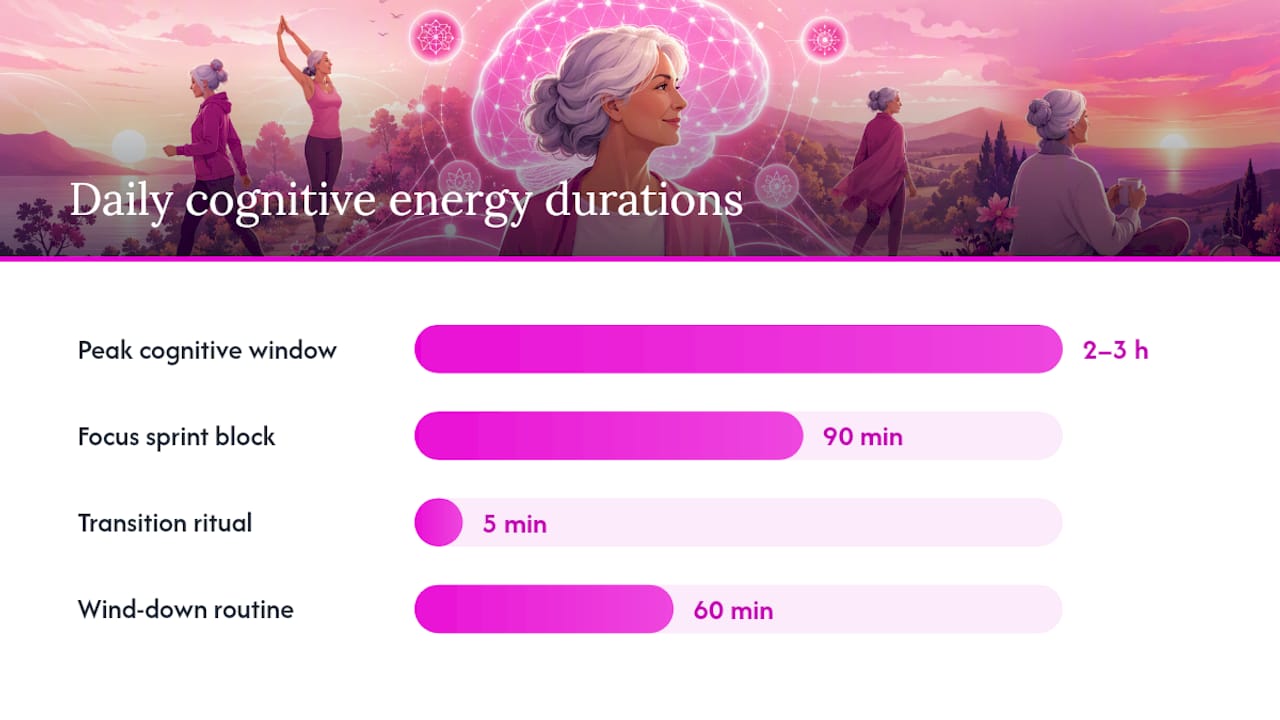
Pro Tip: Before each focus sprint, spend five minutes on a simple pre-task ritual: make tea, clear your desk surface, write one sentence about what you want to finish. That small sequence trains your brain to shift into focus mode on cue — like a warm-up before exercise.
What to eat and drink to support mental clarity
The brain runs on glucose, but the key word is steady. Blood sugar spikes followed by crashes are a direct cause of afternoon fog. A breakfast built around protein and healthy fats — eggs, Greek yogurt, avocado, nuts — slows glucose absorption and keeps energy stable for hours. Skipping breakfast or eating refined carbs alone sets up a mid-morning crash that no amount of coffee fully fixes.

Three dietary patterns consistently show up in research on cognitive health: the Mediterranean diet, the DASH diet, and the MIND diet, which combines elements of both. Harvard T.H. Chan School of Public Health’s review of the MIND diet links this pattern to lower rates of cognitive decline in observational studies. The practical shift is simple: more leafy greens, berries, fish, olive oil, and nuts; less red meat, butter, and ultra-processed food.
| Favor | Limit |
|---|---|
| Leafy greens (spinach, kale) | Ultra-processed snacks and fast food |
| Berries (blueberries, strawberries) | Refined carbohydrates (white bread, pastries) |
| Fatty fish (salmon, sardines) | Saturated fats (butter, full-fat processed meat) |
| Olive oil, avocado, nuts | Sugary drinks and alcohol |
| Whole grains, legumes | Excess caffeine after noon |
Hydration is underrated. Even mild dehydration — before you feel thirsty — slows processing speed. Aim for water consistently through the morning rather than catching up in the afternoon. For women managing menopause symptoms, electrolyte balance can also affect energy and mental clarity, particularly if hot flashes are causing fluid loss.
On caffeine: it works, but timing is everything. Caffeine consumed after noon disrupts sleep architecture even when you fall asleep easily — and poor sleep is the fastest route back to brain fog. Use it early, and read more about caffeine’s specific effects during menopause before leaning on it heavily.
Supplements: Omega-3 fatty acids (DHA in particular) have the strongest observational support for brain health. B vitamins, especially B12, matter if levels are low — deficiency is common after 50 and directly impairs cognition. Magnesium supports sleep quality. Soy isoflavones show mixed results for cognitive symptoms. Lion’s Mane mushroom has early-stage research suggesting nerve growth factor support, though large-scale human trials are still limited. Before starting any supplement, check for interactions with existing medications and discuss with your clinician — this applies especially if you are considering hormone therapy alongside supplements. For a deeper look at options, Nukalove’s brain fog supplement guide covers the evidence and safety considerations.
What does the research say about cognitive training?
The strongest long-term evidence for deliberate cognitive training in older adults comes from the ACTIVE trial. Participants who received targeted training in reasoning and processing speed showed significantly less cognitive decline over a 10-year follow-up compared with control groups, according to NIA’s summary of the findings. The training involved structured, repeated practice — not casual brain games — and the benefits were specific to the domains trained, with some transfer to everyday tasks.
The ACTIVE trial’s 10-year follow-up showed that reasoning and speed-of-processing training produced lasting protective effects against cognitive decline — one of the most durable findings in cognitive aging research. The key was deliberate, repeated practice rather than passive engagement.
What does that look like in daily life? Speed-processing drills (timed reading, rapid word recall), reasoning puzzles (logic games, strategy-based card games), and spaced repetition for learning new material all mirror the trained tasks. Fifteen to thirty minutes, three to five times per week, is enough to build the habit without burning out.
Apps like Lumosity or BrainHQ offer structured versions of these exercises, but they are not magic. The research is clear that transfer to real-life function depends on variety and genuine challenge. Learning a new language, picking up an instrument, or taking a class in something unfamiliar tends to produce broader cognitive benefits than any single app because it demands integration across multiple brain systems simultaneously.
Practical cognitive training habits:
- Read one challenging article daily and summarize it in two sentences before moving on
- Try a new skill that requires both mental and physical coordination (dancing, a new sport, pottery)
- Use spaced repetition apps like Anki for learning new vocabulary or concepts
- Play strategy games (chess, bridge, complex card games) with other people when possible
- Schedule 20-minute reasoning practice sessions three times per week at the same time each day
Pro Tip: Track your focus for two to three weeks before judging results. Small gains show up early — you will notice fewer mid-task interruptions and faster word retrieval. Deeper habit-based shifts typically take six to eight weeks of consistent practice.
When should you see a clinician about focus problems?
Not all focus problems after 50 are menopause-related, and some have straightforward medical fixes. See a clinician promptly if you notice rapid cognitive decline over weeks, difficulty with familiar tasks like driving a known route or managing bills, or significant personality changes alongside memory issues.
For slower-onset fog, a basic workup can rule out the most common reversible contributors:
- Thyroid function (hypothyroidism is common in women over 50 and directly causes cognitive slowing)
- B12 and folate levels (deficiency is widespread and correctable)
- Sleep apnea screening (often undiagnosed in women; causes severe next-day cognitive impairment)
- Depression and anxiety assessment (both impair working memory and are treatable)
- Medication review (anticholinergics, benzodiazepines, some antihistamines, and certain blood pressure drugs all carry cognitive side effects)
- Blood glucose and cardiovascular risk factors (uncontrolled diabetes and hypertension both accelerate cognitive aging)
On hormone replacement therapy: HRT helps some women with menopause-related cognitive symptoms, particularly when started close to the onset of menopause. The evidence is nuanced — timing, formulation, and individual health history all affect the risk-benefit calculation. This is a conversation to have with your gynecologist or a menopause specialist, not a decision to make based on general reading. Harvard Health’s summary of lifestyle factors for brain health is a useful reference to bring to that appointment.
This article is general health information, not a diagnosis or treatment recommendation. Bring any persistent cognitive concerns to your primary care provider or gynecologist for evaluation.
Simple tools and environment hacks to reduce distractions
You do not need a productivity system overhaul. Two tools and one environment change can meaningfully cut distractions within 15 minutes.
Start here: Enable Do Not Disturb on your phone during focus sprints (schedule it automatically so you do not have to remember). Set a 25-minute timer — the Pomodoro technique — for a single defined task. When the timer ends, take a five-minute break before resetting. That structure alone removes the two biggest focus killers: incoming notifications and the open-ended feeling of “how long do I have to do this?”
Beyond the timer: use your phone’s calendar to batch similar tasks (all calls in one block, all email in another) so you are not context-switching all day. Keep a single notepad or app — Google Keep, Apple Notes, or a physical notebook — as your one capture system for stray thoughts during focus sprints. Writing a thought down and returning to it later costs far less attention than acting on it immediately.
Environment: Clear your desk to a single working surface before each sprint. Control light (bright, cool light in the morning supports alertness; warmer, dimmer light in the evening supports wind-down). Designate one physical “drop spot” — a bowl, a hook, a tray — for your phone, keys, and glasses. Reducing the daily search for lost items is a small but real cognitive load reduction.
Your printable 7-item daily focus checklist
Run through this list in two minutes each morning. Check what you did yesterday, plan today, and move on.
- Sleep window: Did you go to bed and wake at consistent times?
- Protein breakfast: Did you eat protein and healthy fat within an hour of waking?
- Focus Sprint 1: Have you blocked 90 minutes for your top task, phone on Do Not Disturb?
- Movement: Have you scheduled at least 20 minutes of physical activity today?
- Hydration: Are you drinking water consistently, not just when thirsty?
- Single-tasking: Are you working on one thing at a time during focus windows?
- Bedtime wind-down: Have you planned a 60-minute screen-free wind-down tonight?
Print it, tape it to your desk, or save it as a phone note. The ritual matters as much as the list — two minutes of intentional planning at the start of each day builds the habit of treating your focus as something worth protecting.
A perspective from Nuka Love
The habit-first approach described in this article works precisely because it does not ask you to overhaul your life. Women over 50 are often managing more complexity than at any earlier point — careers, caregiving, health changes, travel — and the strategies that stick are the ones that fit into real days, not ideal ones.
What gets underestimated is how much the environment shapes cognitive performance. Most focus advice targets willpower, but willpower is a depleting resource. Structuring your morning so that the focused choice is the easy choice — a cleared desk, a pre-set timer, a protein breakfast already planned — removes the friction before it becomes a problem. The same logic applies to supplements: a strip you can take anywhere, without water or preparation, fits into a travel day or a packed schedule in a way that a handful of capsules simply does not.
The research on cognitive training is genuinely encouraging. The ACTIVE trial’s 10-year findings suggest the brain responds to deliberate challenge at any age. But the gap between “knowing this” and “doing it consistently” is where most people stall. Small, repeatable habits — not heroic effort — are what close that gap.
CLARITY Focus Strips are built for women on the move
Brain fog does not pause for travel days, back-to-back meetings, or the weeks when your routine falls apart. That is exactly where CLARITY Focus Strips from Nukalove fit in.

CLARITY strips combine Lion’s Mane and Cordyceps functional mushrooms in a dissolvable oral strip — no water, no capsules, no bag to unpack. Lion’s Mane has early research support for nerve growth factor stimulation; Cordyceps is traditionally associated with energy and stamina. Together, they are designed as a convenient, on-the-go complement to the sleep, nutrition, and single-tasking habits covered in this article — not a replacement for them.
CLARITY is not a substitute for a clinician evaluation if your brain fog is persistent or worsening. Check for interactions with any current medications or HRT before starting, and consult your clinician if you have questions. For women who want a portable, easy-to-use option that travels as well as they do, visit the Nukalove wellness collection or go directly to the CLARITY product page to learn more or join the waitlist.
Key takeaways
Consistent daily habits — sleep, single-tasking, steady nutrition, movement, and deliberate cognitive challenge — produce measurable improvements in focus for women over 50, with early gains typically appearing within two to three weeks and stronger shifts around six to eight weeks.
| Point | Details |
|---|---|
| Start with sleep and nutrition | Consistent sleep timing and a protein-rich breakfast address the two fastest routes to brain fog. |
| Single-task during peak hours | Protecting your morning cognitive window for one priority task outperforms any productivity app. |
| Cognitive training has real evidence | The ACTIVE trial showed reasoning and speed training reduced cognitive decline over 10 years. |
| Rule out reversible causes | Thyroid, B12, sleep apnea, and medication side effects are common and correctable — worth checking. |
| Nukalove CLARITY Strips | A travel-ready Lion’s Mane and Cordyceps strip designed to complement daily focus routines on busy days. |
Sources
These sources are worth bookmarking and bringing to your next clinician visit if you want a research-backed conversation about cognitive health.
- Cognitive health and older adults — National Institute on Aging (NIA)
- How to handle menopause brain fog — NCOA
- How to stay focused at any age — Harvard Medical School
- MIND diet review — Harvard T.H. Chan School of Public Health
Bring the NIA and NCOA links in particular to any appointment where you want to discuss cognitive symptoms — both are recognized clinical references that support a productive conversation with your provider.