

Carry-On Friendly Vitamins: What TSA Actually Allows
Solid vitamins, meaning tablets, capsules, and gummies, can go in your carry-on in any quantity. Liquid vitamins have to follow the standard 3.4 ounce (100 ml) liquids rule, packed inside your one quart bag with everything else. Powdered supplements get their own ceiling: containers over 12 ounces (about 350 ml) can trigger extra screening or need to go in checked luggage instead. That’s the entire rulebook in three sentences. Everything else is just execution.
Here’s the fast version for the morning you’re packing:
- Solids (pills, gummies, capsules): unlimited in carry-on, no bag required.
- Liquids: 3.4 oz or under, in your quart liquids bag.
- Powders: 12 oz or under per container, or check it.
Pro Tip: Take a phone photo of your pill organizer’s contents next to the original bottles before you leave the house. If security asks what’s in an unlabeled compartment, you have proof in ten seconds instead of a slower manual bag check.
Key Takeaways
Carry-on friendly vitamins come down to form: solids travel unrestricted, liquids must stay under 3.4 oz, and powders must stay under 12 oz or move to checked luggage.
| Point | Details |
|---|---|
| Solids have no limit | Tablets, capsules, and gummies pass through carry-on screening in any quantity. |
| Liquids follow 3-1-1 | Liquid vitamins must be 3.4 oz or less and fit in your quart liquids bag. |
| Powders cap at 12 oz | Containers over that threshold risk extra screening or need to go in checked bags. |
| Pack by urgency | Put sleep, energy, and prescription items in carry-on; save bulk powders for checked luggage. |
| Nuka Love fits the rules | Oral strips and single-serve powder sachets from Nuka Love avoid liquid limits entirely and stay under the powder threshold. |
Table of Contents
- What Are the TSA Rules for Carry-On Vitamins?
- Which Vitamin Form Travels Best?
- How Do You Pack Vitamins for Airport Security?
- What Should Women 35 to 60 Actually Pack?
- How Do You Manage Vitamins That Need Refrigeration?
- Do TSA Rules Apply Outside the U.S.?
- Try a Travel-Ready Bundle Before Your Next Trip
- Sources
What Are the TSA Rules for Carry-On Vitamins?
TSA’s own vitamins page lists a plain “yes” for both carry-on and checked bags when it comes to solid vitamins, and treats gummy vitamins the exact same way it treats a bottle of ibuprofen. No cap on how many bottles, no requirement that they stay in original packaging, though original labeling makes your life easier if anything gets flagged.
Liquid vitamins are a different story. They fall under the same 3-1-1 policy as shampoo or contact solution: each container maxes out at 3.4 ounces, and every liquid you’re carrying, vitamins included, has to fit into that single quart-sized clear bag. A liquid multivitamin in a 4 oz bottle doesn’t get a pass just because it’s a supplement rather than a toiletry.
Powders sit in a gray zone that trips up a lot of travelers. TSA caps carry-on powder containers at 12 ounces, and anything larger can mean your collagen tub gets pulled for additional screening, or bag checkers ask you to move it to checked luggage on the spot. Fine, dust-like powders (protein blends, powdered greens) tend to draw more attention on X-ray than coarser ones, so a factory-sealed bag screens faster than a loose scoop container.
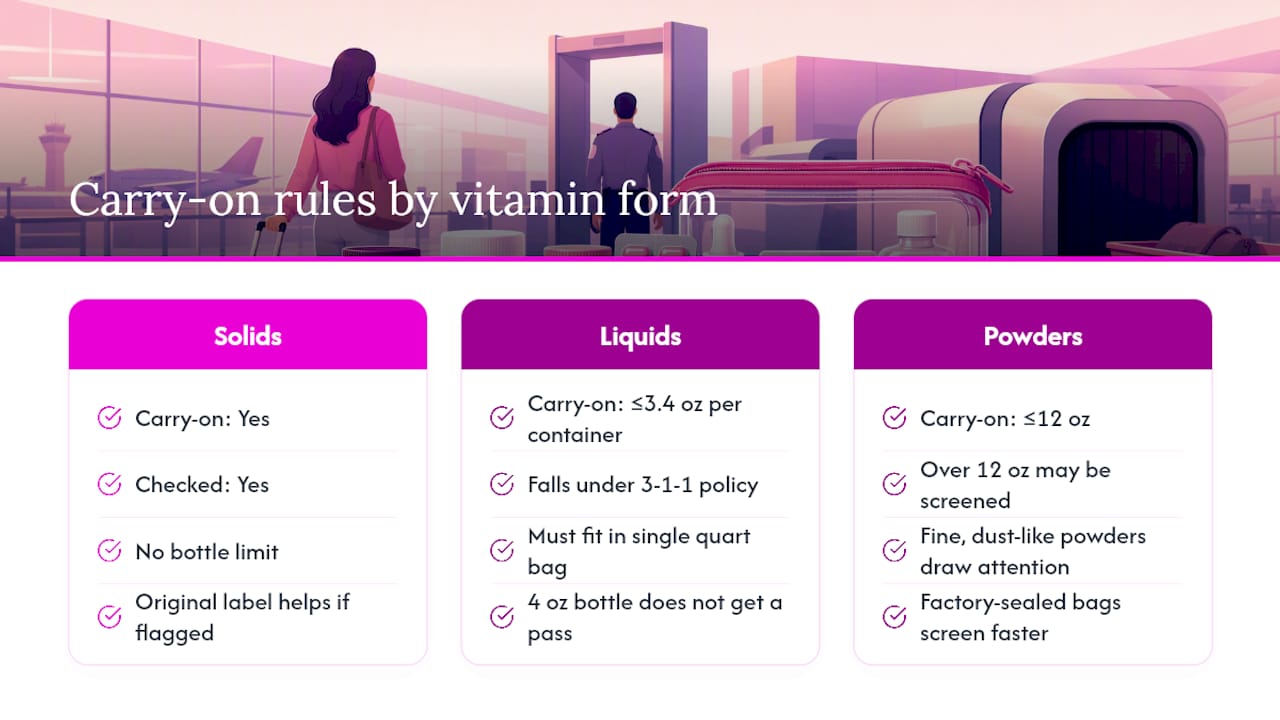
A number worth memorizing: 3.4 oz for liquids, 12 oz for powders. Those two figures cover almost every packing decision you’ll make.
If you’re carrying a prescription vitamin, such as a compounded hormone formulation, pack it separately and be ready to show the pharmacy label. TSA and travel outlets alike note that officers may ask you to declare medically necessary items at the checkpoint, and having the label visible speeds that along.
Pro Tip: Keep liquid and powdered supplements in their smallest possible original container rather than a bulk size you’ve been refilling. Screeners recognize factory packaging on sight; a repurposed jar without a label reads as unknown and gets a second look.
Which Vitamin Form Travels Best?
Not every supplement format survives a carry-on the same way. If you’re rebuilding your travel kit, the physical form matters more than the brand.
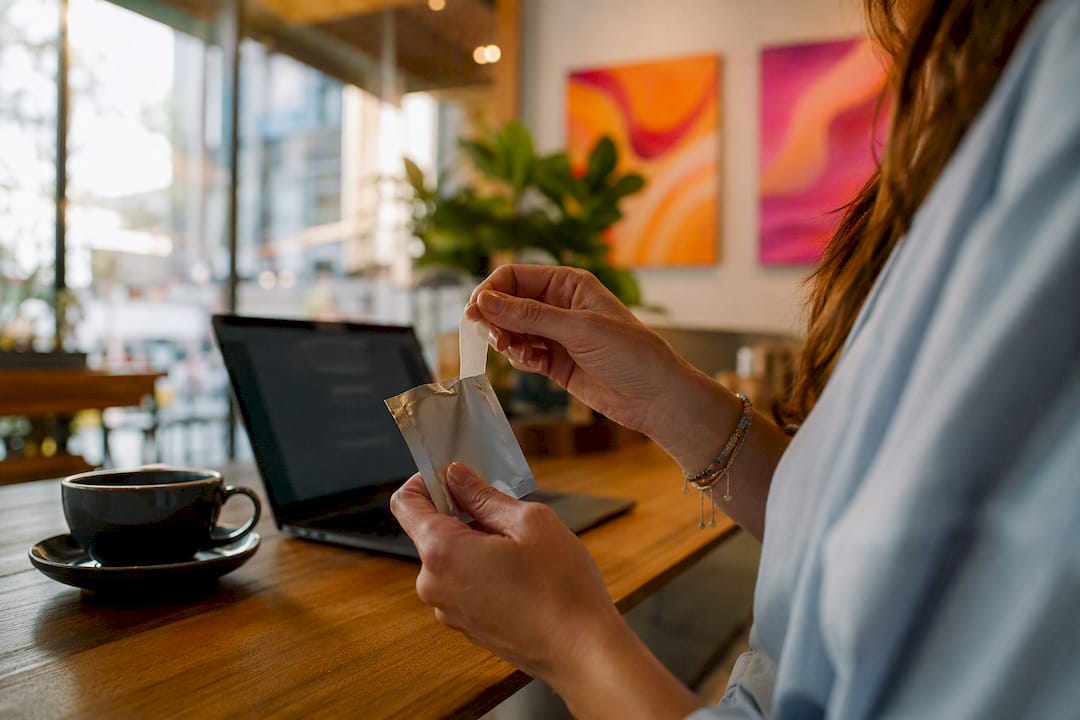
Oral strips are the most carry-on friendly format that exists, full stop. They’re classified as solids, so there’s no 3.4 oz ceiling and no liquids bag to juggle. A week’s worth of strips takes up less room than a single pill bottle, they can’t spill, and they dissolve on your tongue without water, which matters more than you’d think on a red-eye when the drink cart hasn’t come by yet.
Tablets and capsules are the classic choice for good reason: durable, shelf-stable, and completely unrestricted in quantity. Their downside is bulk. A 90-day supply in a big bottle eats pouch space fast.
Gummies are easy to take and kid-tested, but they soften and occasionally fuse together in hot cars, a checked bag near an engine, or a beach tote left in the sun.
Liquids carry the most friction. Beyond the 3.4 oz limit, glass bottles risk breaking and droppers risk leaking, especially with pressure changes at altitude.
Powders pack efficiently for their nutrient density but live under that 12 oz rule and can look suspicious on X-ray if they’re loose or unlabeled.
Nuka Love builds its oral strips and single-serve powder sachets specifically around these constraints. A sleep strip or energy strip weighs almost nothing, needs no water, and a powder sachet under the 12 oz threshold never becomes a security conversation. International travel adds another wrinkle: TSA rules only govern U.S. security screening, so customs rules in your destination country, and any airline’s own carry-on policy, are worth a quick check before you fly.
Pro Tip: If you’re bringing a two-week vacation supply, split it: oral strips or tablets in carry-on for the days you can’t afford to miss a dose, bulk powder or backup bottles in checked luggage.
How Do You Pack Vitamins for Airport Security?
Getting through security without a bag search comes down to sequencing. Do this the night before, not at the gate.
- Sort by form first. Group solids, liquids, and powders into separate small pouches so you’re not digging through one bag for everything.
- Put liquids in the quart bag. Any liquid vitamin or tincture under 3.4 oz goes in with your other toiletries, not loose in your purse.
- Check every powder container. If it’s over 12 oz, either decant into a smaller container or move it to checked luggage before you leave home.
- Keep prescription items separate with labels visible. This includes compounded hormone therapies or anything a pharmacist dispensed by name.
- Do a final walk-through of your carry-on the morning of your flight, confirming nothing shifted into the wrong pouch.
At the checkpoint itself, pull your liquids bag out before the bin, keep your pill organizer accessible rather than buried, and have prescription labels ready if an officer asks. Oversized powder containers are the single most common reason travelers get pulled aside, according to travel outlets covering TSA supplement policy, so front-load that check before you ever reach the belt.
Airtight travel containers protect solids from humidity and crushing. Wrap any glass liquid bottle in a sock or bag interior. Use resealable bags for powder sachets in case a seal weakens under cabin pressure. If you’ve consolidated pills out of their original bottles into an organizer, snap a photo of the original labels first.
On timing: travel guides commonly suggest keeping a 3 to 5 day emergency supply of your daily essentials in carry-on specifically, splitting the rest into checked luggage. That way, if your suitcase gets delayed a day, your sleep and energy routine doesn’t collapse with it.
Pro Tip: Pack one extra day beyond your trip length. Delayed flights home are more common than delayed flights out, and running out of your sleep strip on night one back is a rough way to end a vacation.
What Should Women 35 to 60 Actually Pack?
Midlife travel comes with its own short list of priorities, and not every supplement in your cabinet deserves carry-on real estate.
- Energy and B vitamins: useful for jet lag and the general fatigue of time zone shifts.
- Sleep support that isn’t habit-forming: valuable for adjusting to a new time zone without grogginess the next morning.
- Hydration and electrolytes: cabin air runs drier than most homes, and dehydration worsens hot flashes for many women in perimenopause and menopause.
- Digestive enzymes or probiotics: travel food and irregular meal timing are a common trigger for digestive discomfort.
- Bone and skin support: calcium, vitamin D, and collagen or biotin matter more with age, though they’re lower priority for a short trip’s carry-on.
Pack by urgency, not by habit. A missed dose of your sleep aid or energy support on day one of a trip is disruptive; a missed dose of a bone-support powder on day one is not. Save the bulkier, less time-sensitive powders for checked luggage and reserve carry-on space for what you’d actually notice missing.
Interactions between supplements and prescription medications are one of the most overlooked travel-planning risks. Anyone adding a new sleep aid, electrolyte blend, or energy product to their routine, especially alongside hormone therapy or blood pressure medication, should run it by a pharmacist or doctor before departure, not after landing.
Single-dose strips, chewables, and small powder sachets solve most of this without a second thought, since Nuka Love’s guide to travel supplement options walks through exactly which formats hold up best across a multi-day trip.
How Do You Manage Vitamins That Need Refrigeration?
Some supplements, certain probiotic strains and specific liquid formulations, list refrigeration on the label. Air travel makes that instruction almost impossible to follow literally, and most manufacturers know it.
The practical fix: check the label for a room-temperature window. Many refrigerated probiotics tolerate room temperature for the length of a single travel day without meaningful potency loss, even though the label defaults to “refrigerate” for long-term storage. A small insulated pouch with a single ice pack, the kind sold for insulin, buys you a few extra hours if your itinerary includes a hot layover or a car ride from the airport.
Skip anything that must stay cold the entire trip unless your destination has reliable refrigeration waiting, like a hotel mini fridge you’ve confirmed in advance. Emailing the front desk before you arrive to request a working fridge, not just a minibar, avoids a frustrating discovery at check-in.
This is exactly where format matters. A shelf-stable oral strip or a powder sachet sidesteps the cold-chain problem entirely, since neither requires refrigeration to remain effective for the length of a typical trip. If your daily routine includes something that must stay cold, treat it as the one item you plan around, not an afterthought you remember at the security line.
Do TSA Rules Apply Outside the U.S.?
TSA governs security screening within the United States only. The moment you land somewhere else, or fly a foreign carrier, different rules can apply.
The European Union, the U.K., Canada, and Australia all run broadly similar liquids policies (a version of the 100 ml rule is nearly universal at this point), but powder screening and solid-supplement documentation vary more than most travelers expect. Some countries restrict specific ingredients outright, melatonin is a common one, legal and unrestricted in the U.S. but regulated or prescription-only in parts of Europe.
Before an international trip, check two things separately: your departure country’s screening rules and your destination country’s import and customs rules for supplements. An item that sails through a U.S. checkpoint can still get flagged at customs abroad if it contains a restricted ingredient, even in small personal quantities.
Airlines add a third layer. Individual carriers sometimes impose their own carry-on liquid or gel restrictions tighter than their home country’s baseline, particularly on ultra-low-cost carriers with strict bag limits. When your itinerary crosses borders and airlines, build in a buffer: keep quantities modest, keep original labels intact, and confirm your specific route’s rules a few days out rather than assuming U.S. policy travels with you.
A note from Nuka Love on packing for real life
I think about travel constraints as a design problem, not an inconvenience. Menopause doesn’t pause for a flight schedule, and neither should sleep or energy support. That’s why our strips exist. Take what works for your body, and always loop in your doctor or pharmacist before adding anything new to a medication routine.
Try a Travel-Ready Bundle Before Your Next Trip
If you’ve been eyeing which format to switch to, the smallest possible commitment is the smartest first move. SLEEPY STRIPS solve the jet lag problem without a pill bottle taking up pouch space, GLOW GETTER supports skin and hair through dry cabin air, and CLARITY tackles the fog that hits somewhere around hour six of a long-haul flight. A travel bundle pairing a sleep strip, an energy strip, and a single-serve powder sachet covers the three things travelers ask us about most.
Start small: order a single-strip pack or a short travel bundle to see how your body responds before committing to a larger order or subscription. Browse the full Wellness collection to build a kit around your specific trip length and needs, and pack your next carry-on knowing every strip and sachet already meets TSA’s rules for solids and powders.
Sources
- Liquid Vitamins | Transportation Security Administration
- Can You Bring Supplements on a Plane? | Learn With Superpower
TSA remains the only authority on U.S. screening rules. Treat any other guide, including this one, as helpful context rather than a substitute for checking tsa.gov before an unusual trip.
This article is general information, not a substitute for advice from a qualified doctor. Consult a qualified healthcare professional about your own circumstances before acting on anything here.