

Avoid TSA Delays: Pack Oral Strips for Midlife Women
Yes, TSA allows dietary supplements in both carry-on and checked bags, but the packing rules change depending on the form. Solids like pills and gummies have no quantity limit. Powders over a certain size need separate screening. Liquids follow the standard carry-on size limit for liquids. Keep your daily essentials with you and check destination customs rules before you fly internationally.
TL;DR:
- Supplement powders over 12 ounces may require separate screening or be better packed in checked luggage to avoid delays.
- Liquid supplements over 3.4 ounces must be declared at security and are exempt from size limits if medically necessary, with proper documentation.
- Packing single-serve powders and liquids in small containers or original bottles speeds up TSA screening and reduces the risk of delays.
- Supplements that require refrigeration should be stored in insulated pouches with ice packs or switched to shelf-stable forms for travel.
- Oral strips and other TSA-friendly formats can bypass liquid and powder restrictions, making travel preparation simpler and faster.
Table of Contents
- What TSA Allows by Supplement Form
- How to Pack Supplements in Your Carry-On
- Checked Luggage and Larger Supplies
- International Travel: Customs and Restricted Ingredients
- Packing Checklist and Quick Tips
- Should You Declare Supplements at Security?
- Prescription vs. Over-the-Counter Supplements
- Managing Supplements That Need Refrigeration
- Why Nukalove Built Travel-First Formats
- Travel-Ready Supplements That Fit Your Carry-On
- Official TSA Resources for Verifying the Rules
- Sources
What TSA Allows by Supplement Form
TSA doesn’t treat all supplements the same way, and knowing which category yours falls into saves you time at the checkpoint. The agency confirms vitamins and supplements are allowed in both carry-on and checked baggage, but the screening process depends entirely on whether you’re carrying a solid, a powder, or a liquid.
- Solids (pills, capsules, gummies, tablets): no quantity limit at all. Pack as many bottles as you want, and they typically pass through the X-ray without a second look.
- Powders: anything over roughly 12 ounces (350 mL) in a single container may trigger additional screening or get flagged for checked baggage. Protein powder, greens blends, and collagen tubs fall into this category.
- Liquids, tinctures, and drops: these fall under the standard 3.4 ounce (100 mL) per container rule, and all your liquid containers need to fit inside one quart-sized clear bag.
- Medically necessary liquids: exempt from the 3.4 ounce cap, but you have to declare them to the officer and expect extra screening.
Powders draw more scrutiny than pills for a practical reason: dense powder can obscure what’s underneath it on an X-ray image, which is exactly why officers sometimes ask to swab or visually inspect a large container. Medications and supplements usually screen by X-ray by default, but you’re allowed to ask for a visual inspection instead of X-ray if you’d rather not run something through the scanner. TSA officers make the final call at the checkpoint, and that authority doesn’t change no matter how well you’ve packed.
How to Pack Supplements in Your Carry-On
Packing smart at home means fewer surprises at the checkpoint. A little upfront organizing goes a long way toward keeping your line moving.
- Pull a 3 to 5 day supply of essentials into your carry-on. Think sleep aids, digestive enzymes, energy support, or anything prescription-adjacent you’d hate to lose in checked baggage.
- Choose your container. Labeled pill organizers and original bottles are both acceptable to TSA, but original labels make identification faster if an officer wants to check.
- Bag your liquids properly. Any tincture or liquid supplement over 3.4 ounces needs to go in checked baggage; anything under that limit goes in your quart-sized clear bag with your other liquids.
- Portion your powders. Single-serve packets or containers under 12 ounces sail through without extra screening. Anything larger should either travel in checked luggage or get repacked into smaller containers.
- Expect a separate bin request for powders if an officer asks, and keep containers easy to open in case they want to look inside.
Pro Tip: Pack your quart-sized liquids bag near the top of your carry-on, not buried under clothes. Digging for it while a line forms behind you is the single biggest self-inflicted delay travelers create at security.
Checked Luggage and Larger Supplies
Checked bags remove the size restrictions carry-on rules impose, so full tubs of protein powder and larger bottles of liquid supplements travel just fine there. That flexibility comes with its own trade-offs worth weighing before you decide what goes where.
- Wrap glass bottles in clothing or bubble wrap, then seal them in zip-top bags in case of leaks.
- Position fragile containers toward the center of your suitcase, away from the shell where impact hits hardest.
- Checking bulky powders avoids separate screening entirely, but weigh that against the risk of a delayed or lost bag.
- Always keep a small backup supply of your must-have doses in your carry-on, so a missing suitcase doesn’t derail your routine.
International Travel: Customs and Restricted Ingredients
TSA only controls what leaves a U.S. airport. Once you land, the rules belong entirely to that country’s customs authority, and what’s fine to bring on the plane isn’t automatically fine to bring into the country.
Some ingredients that are completely unregulated in the U.S. are prescription-only or outright restricted elsewhere. Common examples include:
- Melatonin, which requires a prescription in several European countries.
- DHEA, restricted or banned in a number of destinations.
- CBD, legal status varies widely and can carry serious penalties in some countries.
- Botanicals like kava or certain Ayurvedic herbs, which face import restrictions in specific markets.
Before you fly, check the embassy or customs website for your destination. Variability in how supplements are labeled and formulated is a real issue at customs checkpoints, so keeping original labels and ingredient lists on hand helps verify what’s actually in the bottle. If a supplement was prescribed, carry your doctor’s note. When in doubt, travel with a personal-use quantity only, and keep your documentation somewhere you can reach it fast.
Packing Checklist and Quick Tips
Run through this before you zip your bag closed.
- Carry-on: pill packs or organizers, liquids under 3.4 ounces in your quart bag, powder portions under 12 ounces.
- Checked: bulk tubs, spare original bottles, glass items wrapped and sealed.
- Labels: keep every container labeled, and carry a short written list of ingredients for anything unusual.
- Prescriptions: bring the physical prescription or a doctor’s letter for anything prescription-adjacent.
- Backup plan: for common over-the-counter items, buying a replacement at your destination is often easier than overpacking. For anything harder to find, keep a backup dose in your carry-on.
Recommended quantities that travel advisors consistently point to: a 3 to 5 day supply in carry-on covers you if checked luggage gets delayed, while your full supply rides safely in checked baggage.
Should You Declare Supplements at Security?
You don’t need to announce a bottle of multivitamins to a TSA officer. Standard solids, reasonably portioned powders, and liquids under 3.4 ounces move through screening like any other carry-on item, no declaration required.
Declaring matters in two specific situations. First, if you’re carrying a medically necessary liquid supplement over the 3.4 ounce limit, tell the officer before your bag goes through the X-ray. That single sentence, “I have a medically necessary liquid over the limit,” triggers the exception process instead of a confiscation. Second, at international customs on your return or arrival, declare anything that could be flagged as a restricted substance, especially unusual botanicals, high-dose hormone supplements like DHEA, or anything without a clear label.
Being upfront rarely slows you down. Customs officers are far more suspicious of unlabeled containers or vague answers than they are of someone who says, “This is a magnesium supplement for sleep, here’s the label.” Keep your documentation ready but don’t over-explain. State what it is, show the label if asked, and let the officer do their job.
The one place declaring backfires is when you don’t actually need to. Flagging a normal bottle of vitamin D as something noteworthy just invites questions you don’t need. Save the declaration for liquids over the limit and anything genuinely questionable at an international border.
Prescription vs. Over-the-Counter Supplements
The distance between “supplement” and “medication” matters more at customs than it does at TSA. Domestically, TSA treats prescription medications and over-the-counter supplements almost identically for screening purposes, allowing both in carry-on and checked bags with the same form-based rules for solids, powders, and liquids.
The gap opens up once you cross a border. A prescription supplement, hormone therapy, or compounded formula needs to travel with its original prescription label intact, and it’s worth carrying a copy of the actual prescription or a letter from your prescriber. This matters especially for menopause-related prescriptions, since hormone-adjacent ingredients draw more customs attention than a basic multivitamin.
Over-the-counter supplements are lower risk but not risk-free. An ingredient that’s OTC in the U.S., like melatonin or CBD, can be prescription-only or banned outright somewhere else. That’s a customs issue, not a TSA one, and no amount of proper packing protects you from an ingredient your destination doesn’t allow at all.
The practical takeaway: keep prescriptions in their original packaging, carry a doctor’s note for anything hormone-related, and research your destination’s rules for OTC ingredients before you pack them. TSA doesn’t care about the difference. Customs absolutely does.
Managing Supplements That Need Refrigeration
Not every supplement travels at room temperature, and that’s where most packing guides fall short. Certain probiotics, some liquid hormone formulations, and specific women’s health products need consistent cold storage to stay effective.
A small insulated travel pouch with a reusable ice pack handles short flights fine, and most ice packs pass through security without issue as long as they’re frozen solid at the checkpoint (partially melted gel packs sometimes get treated as liquids). For longer trips, call ahead to your hotel and ask about refrigerator access in the room or a shared fridge at the front desk.
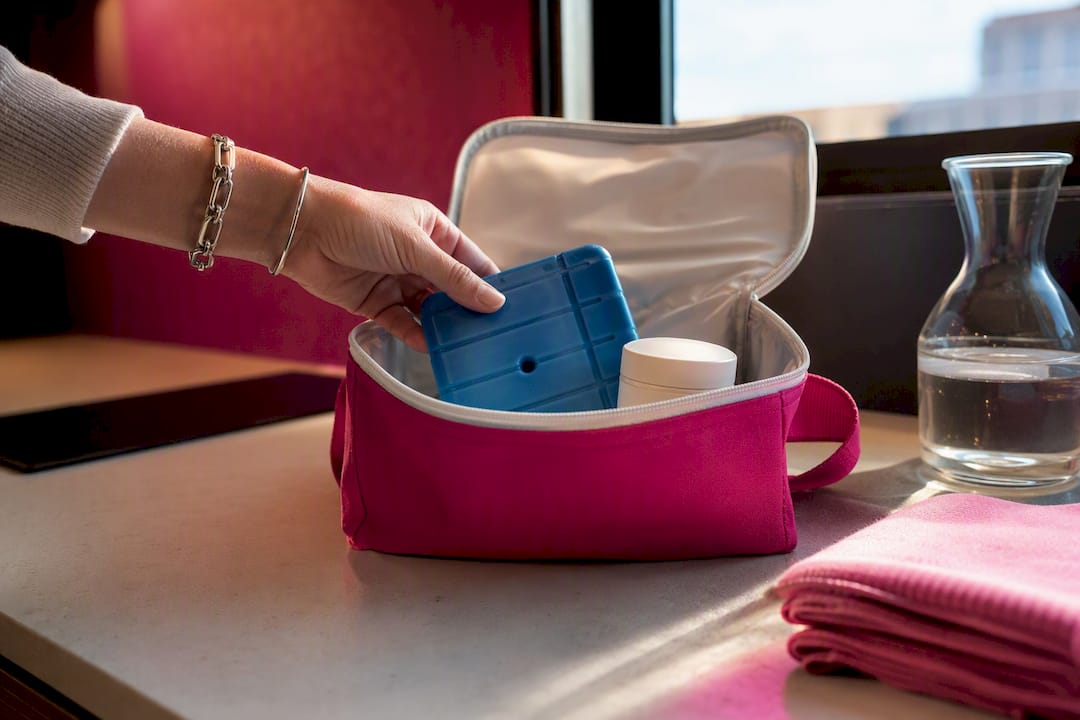
If a refrigerated supplement is medically necessary, that status opens the same TSA exception liquids get: declare it at the checkpoint, and larger quantities become allowable with additional screening. For anything with a short viable window outside the fridge, check the product label for exact tolerance windows. Some probiotics survive 24 to 48 hours unrefrigerated with minimal potency loss; others degrade fast. When your itinerary won’t allow reliable refrigeration, it’s often smarter to switch to a shelf-stable version for the trip and resume your refrigerated routine once you land.
Why Nukalove Built Travel-First Formats
Solids get the easiest pass through TSA screening, and liquids and powders are where most travelers hit friction. That’s exactly the gap Nukalove built around. Oral strips sidestep the 3.4 ounce liquid rule and the 12 ounce powder threshold entirely, because they’re neither. A strip for sleep support before a red-eye flight, or one for energy during a layover crunch, moves through a checkpoint the same way a stick of gum does. For women managing menopause symptoms on top of travel logistics, that’s one less thing to think about at security.
— NUKA
Travel-Ready Supplements That Fit Your Carry-On
Packing smart means choosing formats that never trigger a second look at security in the first place. Nukalove’s oral strips are built for exactly that: no bottle limits to track, no powder threshold to watch, just a flat, single-serve strip that dissolves in seconds.
For a red-eye flight or a time zone shift that wrecks your sleep schedule, the Deep Zzzs oral sleep strips are built for exactly that scenario, no liquid rule and no separate screening bin involved. For skin that dries out fast in recycled cabin air, the Glow Getter oral strips support hydration and skin support without adding a single liquid ounce to your quart bag. Both slide into a jacket pocket or the outer sleeve of your carry-on, and both were designed with exactly the packing headaches this article just walked through in mind. If your next trip has you second-guessing what will survive a TSA checkpoint, start with the strip that matches your travel need and skip the guesswork entirely.
Official TSA Resources for Verifying the Rules
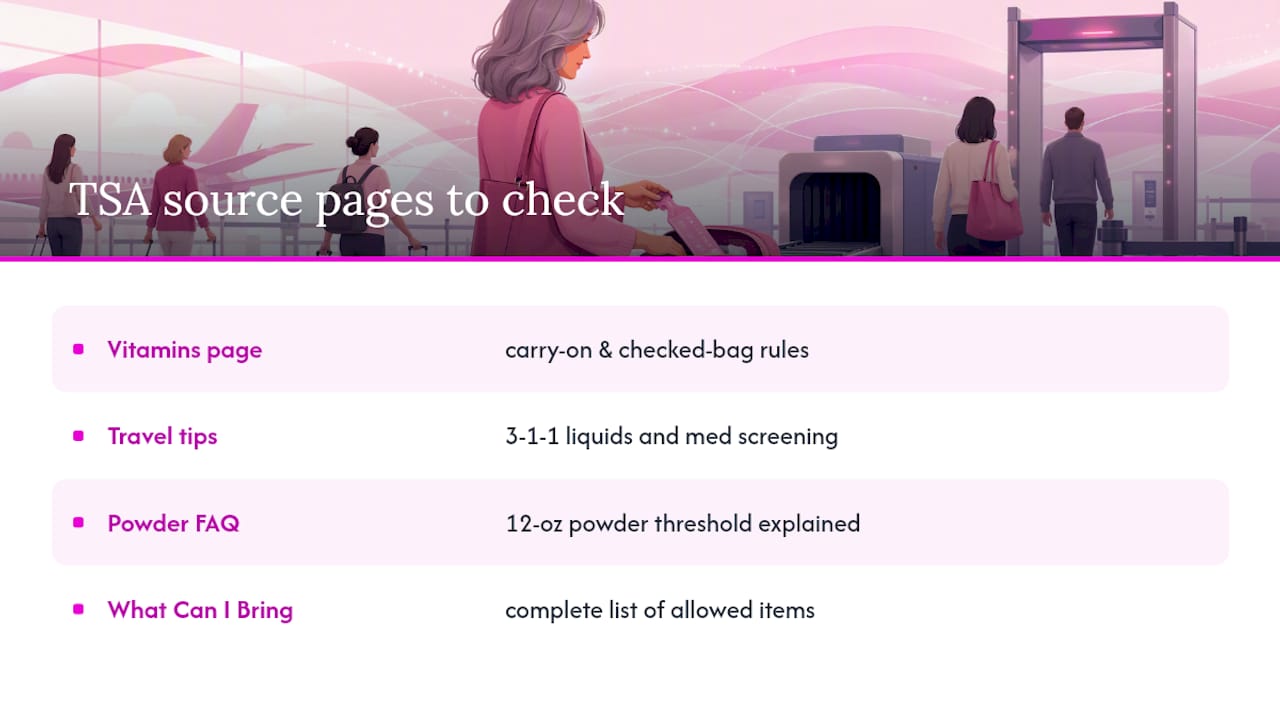
TSA officers make the final admissibility call at every checkpoint, so it’s worth bookmarking the source pages directly. The TSA vitamins page covers the basic carry-on and checked bag rules, while the TSA travel tips page breaks down the 3-1-1 liquids policy and medication screening options. For powder-specific questions, the TSA powder policy FAQ explains the 12 ounce threshold in detail, and the full What Can I Bring? list covers everything else you might be packing alongside your supplements.
This article is general information, not a substitute for advice from a qualified doctor. Consult a qualified healthcare professional about your own circumstances before acting on anything here.
Sources
- Vitamins | Transportation Security Administration
- Can You Bring Supplements on a Plane? | Superpower