

The Best Adaptogens for Menopause Energy, Ranked by Evidence
If fatigue has been dragging you through the day, five adaptogens have the strongest backing for perimenopausal and menopausal energy support: ashwagandha, rhodiola, Korean red ginseng, shatavari, and holy basil. None of them work like a cup of coffee. They support your body’s stress response over weeks, not minutes, which is exactly why they tend to produce steadier energy than caffeine ever does.
Pair any of them with real sleep, regular movement, and stable blood sugar, because adaptogens amplify a solid foundation rather than replace one.
- Ashwagandha: reduced fatigue and stress markers in a 56-day randomized, double-blind, placebo-controlled trial
- Korean red ginseng: improved fatigue and anxiety at 1 to 3 grams daily over 4 to 12 weeks
- Rhodiola: supports mental stamina and reduces the sense of exhaustion tied to chronic stress
- Shatavari: early evidence for perimenopausal brain fog and low energy
- Holy basil: traditionally used for stress resilience, with more limited human trial data
Pro Tip: Pick one adaptogen, start at the low end of its studied dose, and give it 4 to 8 weeks before judging whether it’s working. Check with your clinician first if you take blood thinners, thyroid medication, or blood pressure drugs.
Key Takeaways
Ashwagandha and Korean red ginseng have the most direct clinical trial support for reducing menopausal fatigue, and both require 4 to 8 weeks of consistent use paired with sleep and exercise to show their full effect.
| Point | Details |
|---|---|
| Start with strongest evidence | Try ashwagandha or Korean red ginseng first, since both have direct trial data in menopausal women. |
| Give it time | Expect gradual change over 4 to 8 weeks, not an immediate energy boost like caffeine. |
| Check interactions first | Anyone on blood thinners, thyroid medication, or blood pressure drugs should consult a clinician before starting. |
| Pair with lifestyle basics | Combine any adaptogen with adequate sleep and regular aerobic exercise for the best results. |
| Consider convenient formats | Nuka Love’s travel-friendly oral strips offer a practical way to stay consistent with dosing while traveling or on busy days. |
Table of Contents
- Adaptogens for Menopause Energy: The Five Worth Trying
- What the Clinical Trials Actually Show
- How Adaptogens Actually Affect Your Energy
- Safety Checklist Before You Start an Adaptogen
- Your 4 to 8 Week Adaptogen Trial Plan
- Lifestyle Habits That Make Adaptogens Work Better
- Who’s Behind This Guide and Where Nuka Love Fits
- Side Effects That Show Up Differently During Menopause
- Adjusting Doses From Perimenopause Through Postmenopause
- Why the “Just Take Ashwagandha” Advice Misses the Point
- Try an Adaptogen Without Overhauling Your Routine
- Frequently Asked Questions
- Sources
Adaptogens for Menopause Energy: The Five Worth Trying
Not every adaptogen fits every kind of tired. Some women feel wired-but-exhausted, running on cortisol fumes. Others feel foggy and flat by 2 p.m. Matching the herb to your specific pattern matters more than picking whatever trends on social media.
-
Ashwagandha (Withania somnifera). The 2025 Frontiers trial tested a standardized root extract over 56 days and found meaningful drops in perceived stress and fatigue alongside improved menopause symptom scores. Studies commonly use 300 mg of standardized extract twice daily. This herb tends to help women whose energy crashes are tied to anxiety or a racing mind at night, since it works partly by calming an overactive stress response rather than by revving anything up.
-
Rhodiola rosea. Traditionally used by Scandinavian and Russian populations to fight fatigue during physical and mental strain, rhodiola shows up in the research on stress-related exhaustion and cognitive slowdown. It tends to act a bit faster than ashwagandha, with some women noticing sharper focus within one to two weeks. Typical doses run 200 to 400 mg daily of a standardized extract, taken in the morning since it can feel mildly activating.
-
Korean red ginseng (Panax ginseng). A review of ginseng research in menopausal women found doses of 1 to 3 grams daily, taken for 4 to 12 weeks, improved fatigue, anxiety, and quality-of-life scores. This is one of the better-studied options specifically in middle-aged women, not just general fatigue populations, which gives it more direct relevance to menopause than many other herbs on this list.
-
Shatavari (Asparagus racemosus). Long used in Ayurvedic medicine for female reproductive health, shatavari has newer, smaller trial data suggesting it may ease brain fog and fatigue in perimenopausal women, with some benefit appearing by four weeks and peak effect closer to twelve. The evidence base here is thinner than ashwagandha’s or ginseng’s, so treat it as promising rather than proven.
-
Holy basil (Tulsi) and secondary options. Holy basil, licorice root, and schisandra all appear in traditional adaptogen formulas for stress and vitality, but human trial data specific to menopausal fatigue is limited. They’re reasonable to combine with a better-studied herb, not to lead with.
If nighttime anxiety is stealing your daytime energy, lean toward a calming adaptogen like ashwagandha. If you’re sleeping fine but still dragging by midday, rhodiola or Korean red ginseng are the more stimulating picks worth trying first.
What the Clinical Trials Actually Show
The strongest data point for this category comes from a randomized, double-blind, placebo-controlled trial published in Frontiers in Reproductive Health in 2025. Researchers gave menopausal women a standardized ashwagandha root extract for 56 days and tracked changes against a placebo group. The results showed statistically significant improvements in Menopause Rating Scale scores, better quality-of-life measures on the SF-12, and reductions in perceived stress and fatigue. Hot flash frequency also dropped in the treatment group.
Korean red ginseng has a somewhat broader evidence trail. A review compiling multiple clinical trials found consistent benefit for fatigue and anxiety at doses between 1 and 3 grams daily, sustained over 4 to 12 weeks. Because several separate small trials point the same direction, this gives red ginseng a bit more consistency than a single trial can offer, even though individual study sizes remain modest.
Beyond these two herbs, the picture gets murkier. A broader systematic review of herbal remedies for menopausal symptoms found moderate evidence for a handful of botanicals and genuinely mixed results across the rest, with individual response varying widely and interaction risks worth taking seriously.
A few things worth setting expectations around:
- Effect sizes in these trials are real but modest, not dramatic. Nobody in these studies went from exhausted to hyper-energized overnight.
- Timelines matter. Most benefit showed up between four and eight weeks, not within days.
- Sample sizes in menopause-specific adaptogen trials tend to run smaller than in general population fatigue research, so results deserve a measure of caution even when they’re statistically significant.
Use this evidence to calibrate your own trial. Expect a gradual shift in how depleted you feel, paired with lifestyle changes, not a single-herb fix.
How Adaptogens Actually Affect Your Energy
Adaptogens don’t flood your system with stimulants. They work mostly by influencing your hypothalamic-pituitary-adrenal axis, the feedback loop that governs how your body produces and clears cortisol. When that axis runs in overdrive from chronic stress or hormonal shifts, energy crashes and sleep disruption often follow. Herbs like ashwagandha appear to help stabilize that loop rather than override it, which is part of why the effect builds over weeks instead of hours.
- HPA axis modulation: helps prevent the cortisol spikes and crashes that leave you wired at night and drained by afternoon
- Neurotransmitter support: some adaptogens show mild GABA-like activity, which can improve sleep quality and indirectly lift next-day energy
- Cellular energy production: rhodiola and ginseng are studied for potential mitochondrial support, the cellular machinery that converts nutrients into usable energy
- Contrast with caffeine: stimulants force a short-term spike and a later crash, while adaptogens aim for a steadier baseline over time
That slower mechanism is the tradeoff. You’re not getting a jolt. You’re getting a system that’s less likely to swing so hard in the first place.
Safety Checklist Before You Start an Adaptogen
Adaptogens are generally well tolerated in trials, but “well tolerated” doesn’t mean risk-free for everyone. A few groups need to slow down before adding one to a daily routine.
- Check for drug interactions first. Ashwagandha, rhodiola, and ginseng can interact with anticoagulants, thyroid medications, blood pressure drugs, and sedatives. Anyone on these medications should talk to a clinician before starting.
- Avoid without clinical clearance if pregnant, breastfeeding, managing uncontrolled thyroid or endocrine disease, or scheduled for surgery soon. These are exactly the situations where herb-drug interactions or hormonal effects carry outsized risk.
- Product quality varies enormously. Look for standardized extracts, such as KSM-66 for ashwagandha, since trial-tested extracts don’t always match what’s on a random supplement shelf. Adulteration and mislabeling are documented problems in the herbal supplement market, so third-party testing matters.
- Multi-herb blends make troubleshooting harder. If a product combines five adaptogens, you won’t know which one is helping or causing a side effect.
- Stop and seek care if you notice an allergic reaction, new heart palpitations, severe stomach upset, or a worsening mood.
Pro Tip: If you’re already on a prescription medication for blood pressure, thyroid function, or mood, bring the specific adaptogen and dose to your next appointment rather than asking a general “is this safe” question. Your clinician needs the exact herb and milligram amount to check for real interaction risk.
Your 4 to 8 Week Adaptogen Trial Plan
Testing one adaptogen properly takes a bit of structure. Random dosing for a week, then giving up, tells you nothing.
- Pick one herb and start low. Ashwagandha trials commonly begin around 300 mg once daily before moving to 300 mg twice daily; ginseng trials often start near 1 gram daily before scaling toward 3 grams.
- Log daily for the first two weeks. Rate your energy on a simple 1 to 10 scale each afternoon, note sleep hours, mood, and any side effects like stomach upset or headache.
- Hold the dose steady for at least four weeks before deciding it isn’t working. Most trial benefits emerged between weeks four and eight, not week one.
- Adjust only one variable at a time. If you want to add a second supplement or start a new medication, wait until the adaptogen trial is finished so you can actually tell what’s helping.
- Reassess at eight weeks. Meaningful improvement in your energy log means continue; no change or new side effects means stop and consider a different herb.
Lifestyle Habits That Make Adaptogens Work Better
No herb outperforms the basics. Harvard Health’s guidance on perimenopause points to sleep and exercise as the two highest-confidence levers for energy, ahead of any single supplement.
- Aim for adequate sleep and regular moderate aerobic activity, as recommended by Harvard Health, for managing menopausal energy dips.
- Favor low-glycemic meals and steady hydration over sugar-heavy quick fixes, since blood sugar swings mimic and worsen fatigue.
- Exercise doesn’t just burn calories. It improves deep sleep and mood, both of which feed directly into how alert you feel the next day, according to Harvard Health’s research on energy. Nutrition timing also matters here; a practical guide to menopause nutrition covers meal patterns that support steadier hormone and energy balance.
- Pace your day. Front-load demanding tasks earlier when energy tends to run higher, and build in short recovery breaks instead of pushing through until you crash.
Who’s Behind This Guide and Where Nuka Love Fits
Nuka Love is a women owned and operated wellness brand built specifically around the realities of perimenopause and menopause, with a focus on travel-friendly oral strips that dissolve without water. That format matters for the exact problem this article covers: fitting a consistent supplement routine into a life that includes flights, work trips, and days too packed for measuring powders.
- Product line built for portability and discreet, fast use during travel or busy workdays
- Editorial content reviewed against clinical trial data, not just traditional-use claims
- Always consult a clinician before combining any adaptogen with prescription medication or existing health conditions
| Point | Details |
|---|---|
| Best evidence | Ashwagandha and Korean red ginseng have the strongest human trial data for menopausal fatigue. |
| Convenient format | Oral strips suit women who need consistent dosing while traveling or juggling packed days. |
| Consult before combining | Always check with a clinician when adding an adaptogen to existing medications. |
Side Effects That Show Up Differently During Menopause
Adaptogens carry a generally mild side effect profile in trials, but menopause changes the picture slightly. Fluctuating estrogen already affects how your body processes stress hormones, so some effects that would be minor in a younger population deserve more attention here.
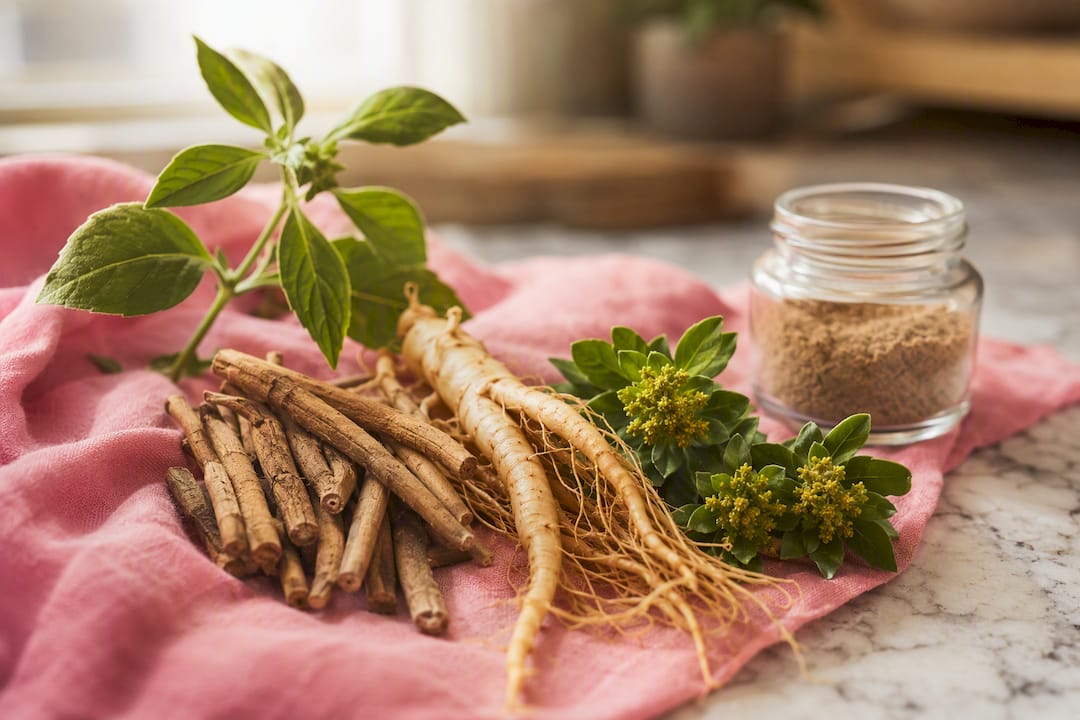
Ashwagandha can occasionally cause drowsiness or mild stomach upset, but because it also lowers cortisol, women already dealing with low blood pressure or on blood pressure medication may notice more pronounced dizziness than younger users report. Ginseng’s mildly stimulating effect can worsen hot flashes or night sweats in some women, even as it improves daytime fatigue, which is worth tracking separately in your symptom log rather than lumping “energy” and “hot flashes” into one vague impression. Rhodiola’s activating quality occasionally aggravates the anxiety or irritability some women already experience during hormonal shifts, so starting at the lowest end of the dose range and taking it earlier in the day helps you gauge tolerance before increasing.
Shatavari, because of its traditional use for reproductive hormone support, warrants extra caution for anyone with a personal or family history of hormone-sensitive conditions. Discuss it specifically with a clinician rather than assuming it’s automatically safe because it’s plant-based. Herbal does not mean risk-free, especially when your baseline hormone levels are already shifting.
Adjusting Doses From Perimenopause Through Postmenopause
Perimenopause and postmenopause aren’t the same hormonal environment, and dosing decisions should reflect that difference.
During perimenopause, estrogen and progesterone fluctuate unpredictably, sometimes swinging within the same month. This is often when calming adaptogens like ashwagandha prove most useful, since erratic hormone shifts frequently show up as anxiety-driven fatigue and disrupted sleep. Starting at a conservative dose, such as 300 mg once daily, and reassessing every few weeks makes sense given how much your baseline can shift during this window.
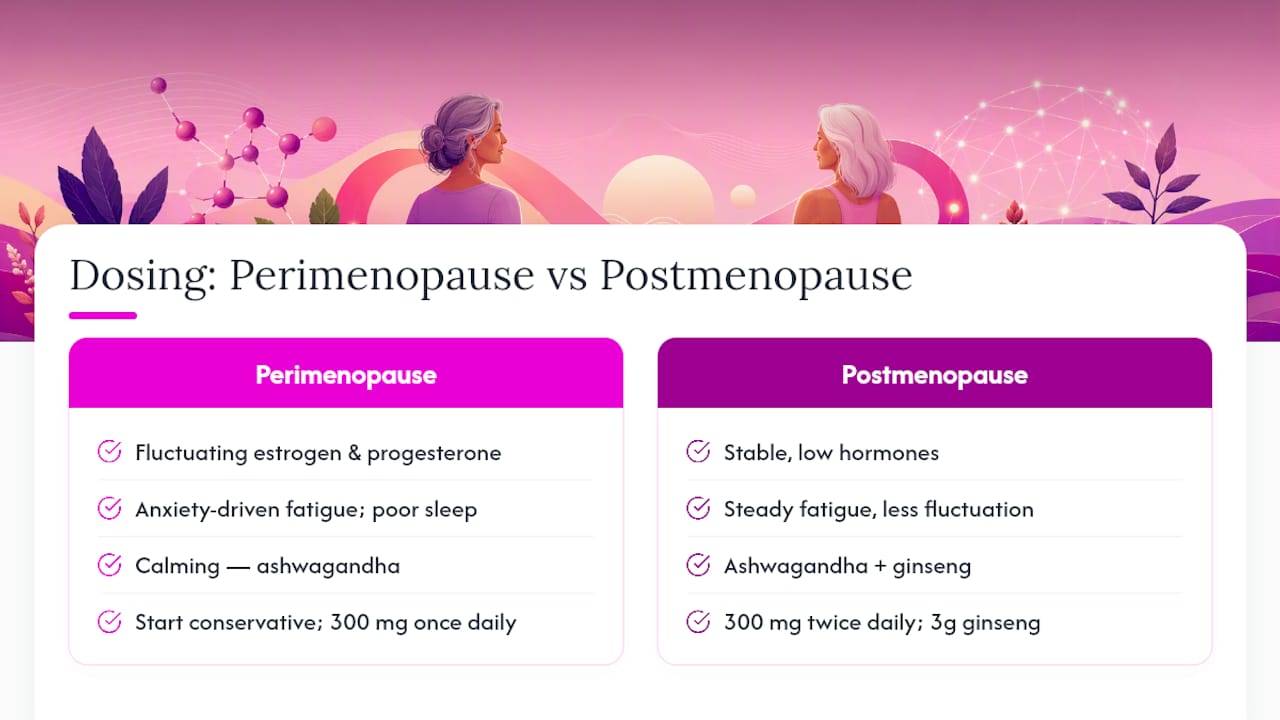
Postmenopause brings more stable, consistently low hormone levels. Fatigue at this stage tends to be steadier and less tied to daily hormonal swings, which means some women tolerate slightly higher doses within studied ranges, such as ashwagandha’s 300 mg twice daily or ginseng’s higher end near 3 grams daily, more predictably than during the perimenopausal rollercoaster. Even so, “postmenopausal” doesn’t mean “no monitoring.” Continue tracking energy and side effects for the first eight weeks at any new dose, and loop in a clinician anytime you’re on medication for blood pressure, thyroid conditions, or mood, regardless of which menopause stage you’re in.
Prose sentence: Ashwagandha and Korean red ginseng carry the strongest trial evidence for menopausal fatigue, and both work best combined with consistent sleep and exercise, not as standalone fixes.
Why the “Just Take Ashwagandha” Advice Misses the Point
Most articles on this topic hand you a single herb and call it done. That’s lazy, and the evidence doesn’t support it. Ashwagandha’s trial data is genuinely strong, but it’s strong for a specific kind of fatigue: the wired, anxious, sleep-disrupted exhaustion tied to cortisol dysregulation. If your fatigue looks more like flat, foggy, low-motivation afternoons, Korean red ginseng or rhodiola fit the evidence better.
The bigger blind spot in most guidance is timeline honesty. Plenty of supplement marketing implies fast results. The actual trial data says four to eight weeks, sometimes longer, and that mismatch is why so many women quit an adaptogen right before it would have worked. Overrated: mixing five adaptogens into one blend and hoping something sticks. Underrated: a boring, single-herb trial with a daily log, run long enough to mean something.
What should come first isn’t the herb at all. It’s sleep and movement, since the research consistently ranks these above any single supplement for energy. Adaptogens earn their place as the second layer, not the first move.
Try an Adaptogen Without Overhauling Your Routine
Buying capsules, remembering water, and timing doses around a travel schedule is its own kind of exhausting, especially during a season when you’re already managing enough. Nuka Love built its products specifically around that friction: fast-dissolving oral strips you can use without water, mid-flight, mid-meeting, or wherever your day takes you.
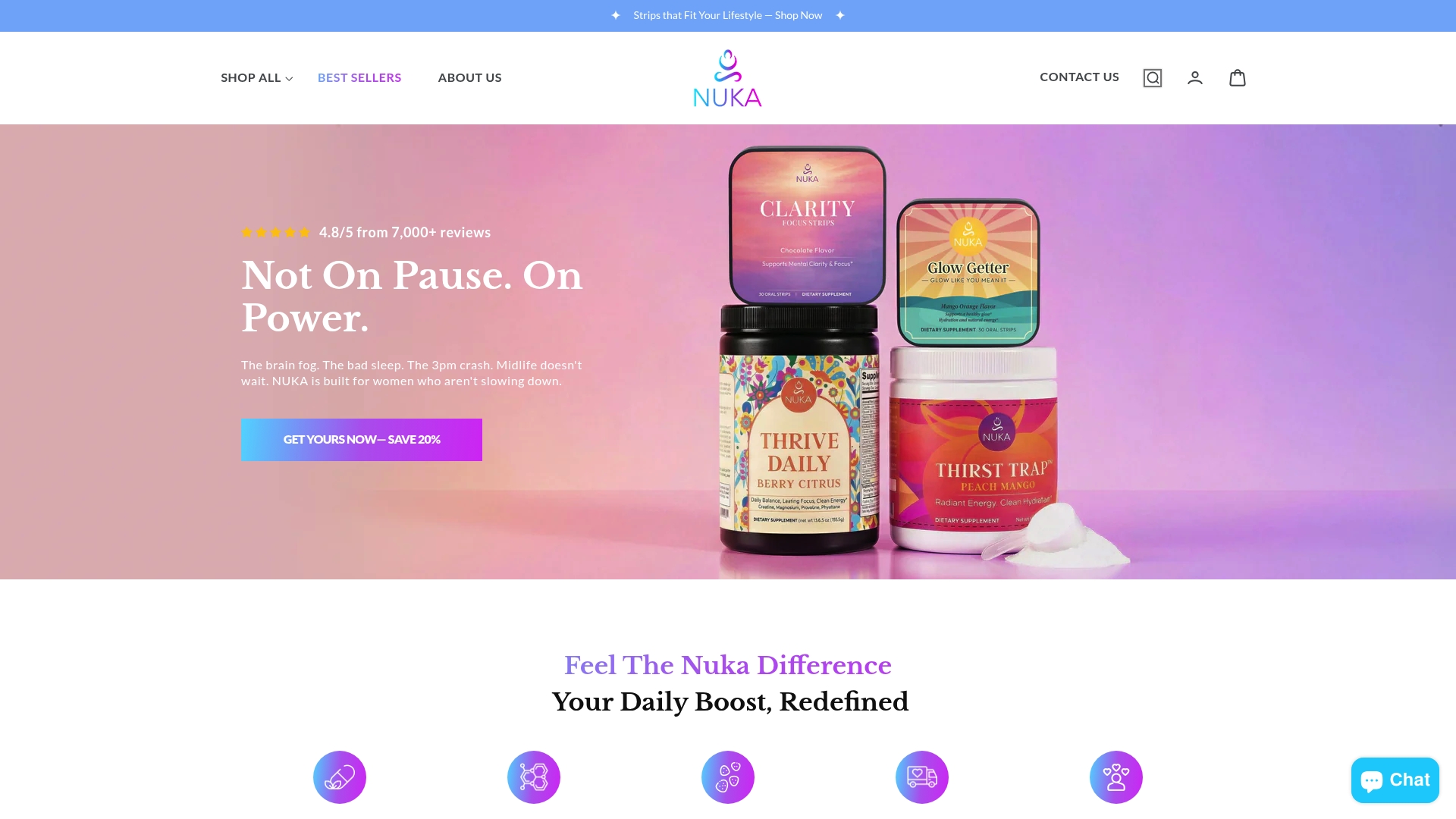
For readers ready to start the trial plan outlined above, the Glow Getter oral strips offer a portable option worth exploring, and the broader wellness collection covers additional support for energy and related menopause symptoms. If sleep disruption is part of your fatigue picture, the Deep ZZZs oral sleep strips are designed to address that piece specifically. Browse the full lineup at Nuka Love and pick the format that fits how your days actually run, not how a pill bottle assumes they run.
Frequently Asked Questions
Do adaptogens work like caffeine for menopause fatigue? No. Adaptogens work gradually by supporting your stress response system rather than delivering an immediate stimulant hit. Expect steadier, more durable energy over weeks, not a quick jolt.
How long before I notice a difference with adaptogens for menopause energy? Most clinical trials measuring adaptogens for menopause energy show meaningful change between four and eight weeks of consistent use, based on the 56-day ashwagandha trial and similar ginseng research.
Can I take more than one adaptogen at once? Starting with a single herb makes it far easier to track what’s actually helping or causing side effects. Combine adaptogens only after you understand how each one affects you individually.
Are adaptogens safe with hormone therapy? Possibly, but this depends on your specific medications and health history. Talk to your clinician before combining adaptogens with hormone therapy or other prescriptions.
Which adaptogen has the strongest research for menopause specifically? Ashwagandha and Korean red ginseng currently have the most direct clinical trial support in menopausal populations, compared with more limited or emerging data for shatavari and holy basil.
This article is general information, not a substitute for advice from a qualified doctor. Consult a qualified healthcare professional about your own circumstances before acting on anything here.
Sources
- A prospective, randomized, double-blind, placebo-controlled study on efficacy and safety of Ashwagandha root extract (Withania somnifera) for managing menopausal symptoms in women
- The beneficial potential of ginseng for menopause
- Outsmarting perimenopause — Harvard Health
- Herbal therapies and their evaluation for menopausal symptoms (systematic review)